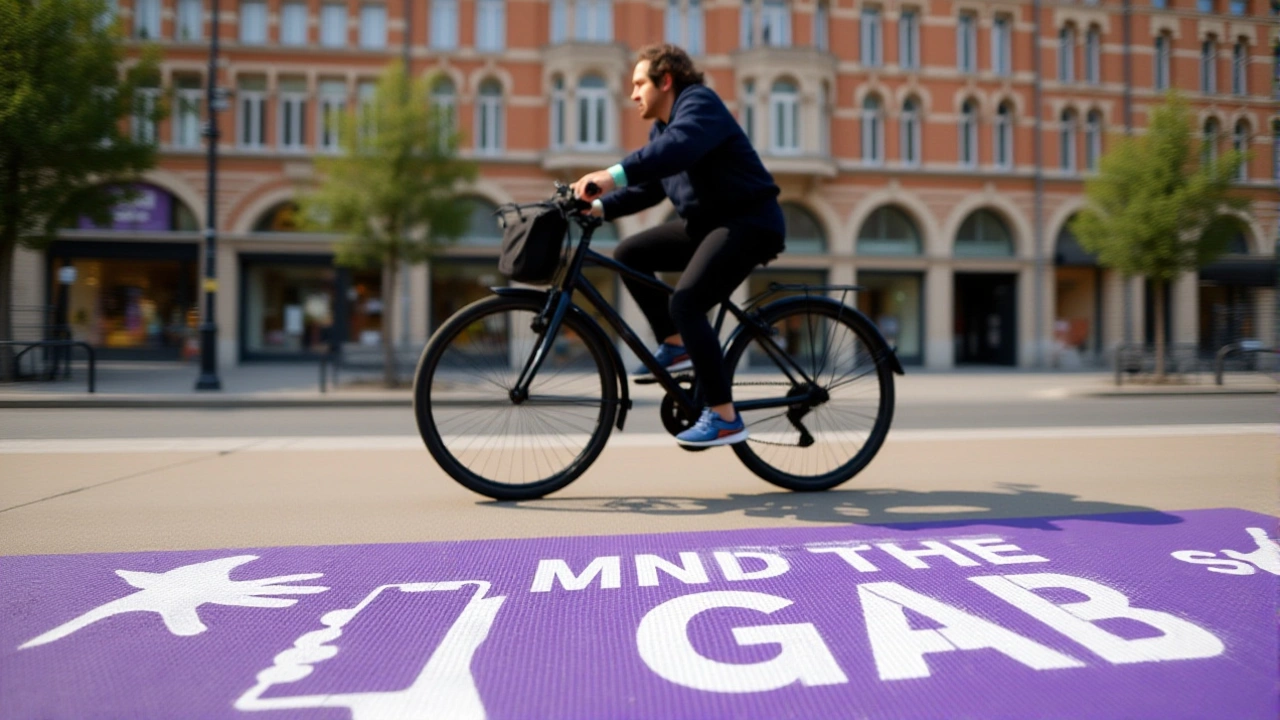
On August 6, 2025, a bold new experiment in urban safety began on one of London’s busiest shopping strips: a vibrant purple line painted across the pavement outside Currys PLC’s flagship store at 293-297 Oxford Street. It wasn’t art. It wasn’t a fashion statement. It was a warning — Mind the Grab — a direct, clever riff on the iconic Mind the Gap that has guided Tube commuters for decades. The message? Step back. Hide your phone. Don’t be the target.
Why Oxford Street? Because That’s Where the Theft Happens
Westminster, the borough that includes Oxford Street, saw 34,203 mobile phones stolen in 2024 — that’s 94 a day, or one every 15 minutes. The numbers aren’t just statistics. They’re lived experiences. A mother checking her bank balance while waiting for a bus. A student snapping a selfie near Selfridges. A tourist scrolling maps on a crowded sidewalk. All vulnerable. All targeted by offenders on bikes and mopeds who move faster than the police can respond.
The Metropolitan Police Service confirmed the trend is worsening. While patrols have increased in hotspots like Leicester Square and Soho, clearance rates remain abysmal. One case documented by The Spectator Australia showed a theft caught on five CCTV cameras — yet closed within 48 hours with no arrests. That’s not just inefficiency. It’s despair for victims.
A Nudge, Not a Law
Currys PLC’s Currys PLC didn’t propose more cameras or stricter penalties. They didn’t lobby for new legislation. Instead, they turned to behavioral science. The purple line — a simple, visually arresting nudge — is designed to trigger subconscious caution. It’s not a rule. It’s a reminder. And it’s backed by research from Birkbeck, University of London's Institute for Crime & Justice Policy Research (ICPR), led by Professor Mai Sato.
"We’re not telling people what to do," Sato explained. "We’re creating a moment of pause. When someone sees that purple line, their brain connects it to the Underground’s familiar warning. That association triggers a protective instinct — step back, look around, tuck the phone away. It’s subtle, but psychology shows these small cues work."
The campaign’s timing is deliberate. In 2024, a Currys-commissioned survey found 77% of Britons considered phone snatching a major problem. In London, that number jumped to 88%. People are already changing their behavior — avoiding phone use in public, hunching over devices, standing with their backs to walls. Mind the Grab doesn’t ask them to change habits. It reinforces the ones they’ve already started.
Partnerships That Matter
This isn’t a corporate stunt. It’s a coalition. Westminster City Council, represented by Aicha Less, Deputy Leader, called the campaign "a practical, community-driven response to a growing crisis." The Metropolitan Police Service is sharing real-time crime data with ICPR researchers. Crimestoppers UK is amplifying the message: "If you see something, say something — anonymously."
Currys has also rolled out a new staff training program at its Oxford Street store. Employees now know how to help victims immediately — calling loved ones, guiding them to report thefts, helping cancel cards, arranging safe rides home. "It’s not just about selling phones," said Ed Connolly, Currys’ Chief Commercial Officer. "It’s about protecting the people who buy them. Phone theft isn’t just about losing a device — it’s frightening, invasive, and cuts people off from their loved ones, their money, and their daily lives. Enough is enough."
What’s Next? The Science Will Tell Us
ICPR’s evaluation is rigorous. Over the next six months, researchers will:
- Systematically observe pedestrian behavior before and after the purple line’s installation
- Analyze crime data from Westminster to detect changes in theft rates
- Conduct public surveys to measure awareness and behavioral shifts
If the data shows even a 15% reduction in thefts in the pilot zone, the campaign could expand to other high-risk areas — Birmingham, Manchester, Glasgow. The goal isn’t to eliminate theft entirely. It’s to make it harder. To make it less profitable. To give people back a sense of safety on their own streets.

What This Means for Everyone
This isn’t just about London. It’s about how cities respond to crime in the digital age. We don’t need more surveillance. We need smarter design. Mind the Grab proves that small, low-cost interventions — grounded in behavioral science — can have outsized impact. It also exposes a deeper truth: when institutions fail to protect us, corporations sometimes step in. Currys didn’t have to do this. But they did. And that’s a sign of how urgent the problem has become.
For now, the purple line remains. Pedestrians pause. Phones disappear into bags. The thieves? They’re still out there. But now, they’re a little less likely to find an easy target.
Frequently Asked Questions
How effective is the purple line at reducing phone thefts?
The effectiveness is still being evaluated by Birkbeck’s ICPR, with initial data collection underway since August 6, 2025. Early observational studies suggest pedestrians are stepping back from the kerb more frequently near the markings, and crime data from Westminster will be compared over a six-month period to determine if thefts in the pilot zone have decreased. A 15% reduction would be considered a meaningful success.
Why was Oxford Street chosen for the pilot?
Oxford Street saw over 1,500 phone thefts in 2024 alone — the highest density in Westminster. With 25 million visitors annually, it’s a prime target for snatch-and-grab criminals. Currys’ flagship store sits at the heart of this hotspot, making it an ideal location to test whether a visible behavioral nudge can shift public habits in a high-traffic, high-risk zone.
What should I do if I’m a victim of phone theft?
Currys staff at Oxford Street are now trained to assist victims by helping them contact loved ones, report the theft to police via the Metropolitan Police Service’s non-emergency line, cancel payment cards linked to the device, and arrange safe transport home. Victims should also report to Crimestoppers anonymously if they witnessed suspicious behavior — even small details can help track repeat offenders.
Is this campaign only about raising awareness, or will it lead to arrests?
The campaign is primarily preventive — it doesn’t aim to increase arrests directly. Instead, it reduces opportunities for theft by changing behavior. However, Crimestoppers UK encourages the public to report suspicious activity, which feeds intelligence to the Metropolitan Police Service. While arrests remain rare, even one tip can disrupt a known gang’s operations, especially if patterns emerge from multiple reports.
Could this purple line become a permanent feature in London?
If the ICPR evaluation shows a statistically significant drop in thefts and sustained behavioral change, Westminster City Council has indicated interest in expanding the markings to other high-risk areas like Camden High Street and Croydon’s Centrale. The cost per marking is under £500, making it far cheaper than installing hundreds of CCTV cameras — and far more humane.
Why did Currys, a retailer, take the lead on this issue?
Currys sells over 1.2 million mobile phones annually in the UK. When customers lose those devices to theft, it affects trust, returns, and brand reputation. But more than that, Ed Connolly and his team recognized a moral responsibility — customers weren’t just buying tech, they were buying safety. The campaign turns customer anxiety into collective action, positioning Currys not just as a seller, but as a protector.




Written by Barclay Westmoreland
Hi there! I'm Barclay Westmoreland, an entertainment expert with a passion for all things cruise-related. As a seasoned traveler and performer, I've had the privilege of exploring the world's most luxurious cruise lines and have made it my mission to share my experiences with others. I thoroughly enjoy writing about the latest trends, exciting destinations, and unique onboard experiences, aiming to inspire and inform fellow cruise enthusiasts. Whether you're a first-time cruiser or a seasoned sailor, I'm here to help you navigate the vast world of cruise entertainment.
All posts: Barclay Westmoreland